What Is a Transfer Credit Evaluation?
A transfer credit evaluation shows how your prior credits may count toward a new degree. Learn the difference between accepted credits, applied credits, and remaining requirements.
A transfer credit evaluation is the process a college uses to review your previous credits and decide how they may count toward a new degree.
If you are an adult learner trying to finish a bachelor’s degree, this evaluation matters a lot. It can affect how many classes you still need, how long it may take to finish, and how much the degree may cost.
But there is one important point to understand from the beginning:
A transfer credit evaluation is not just about how many credits a school accepts. It is about how many credits apply to your specific degree requirements and reduce what you still need to complete.
That difference is where many adult learners get surprised.
A transfer credit evaluation should tell you more than how many credits a school recognizes. It should also show how those credits apply to your specific degree and what requirements you still need to complete.
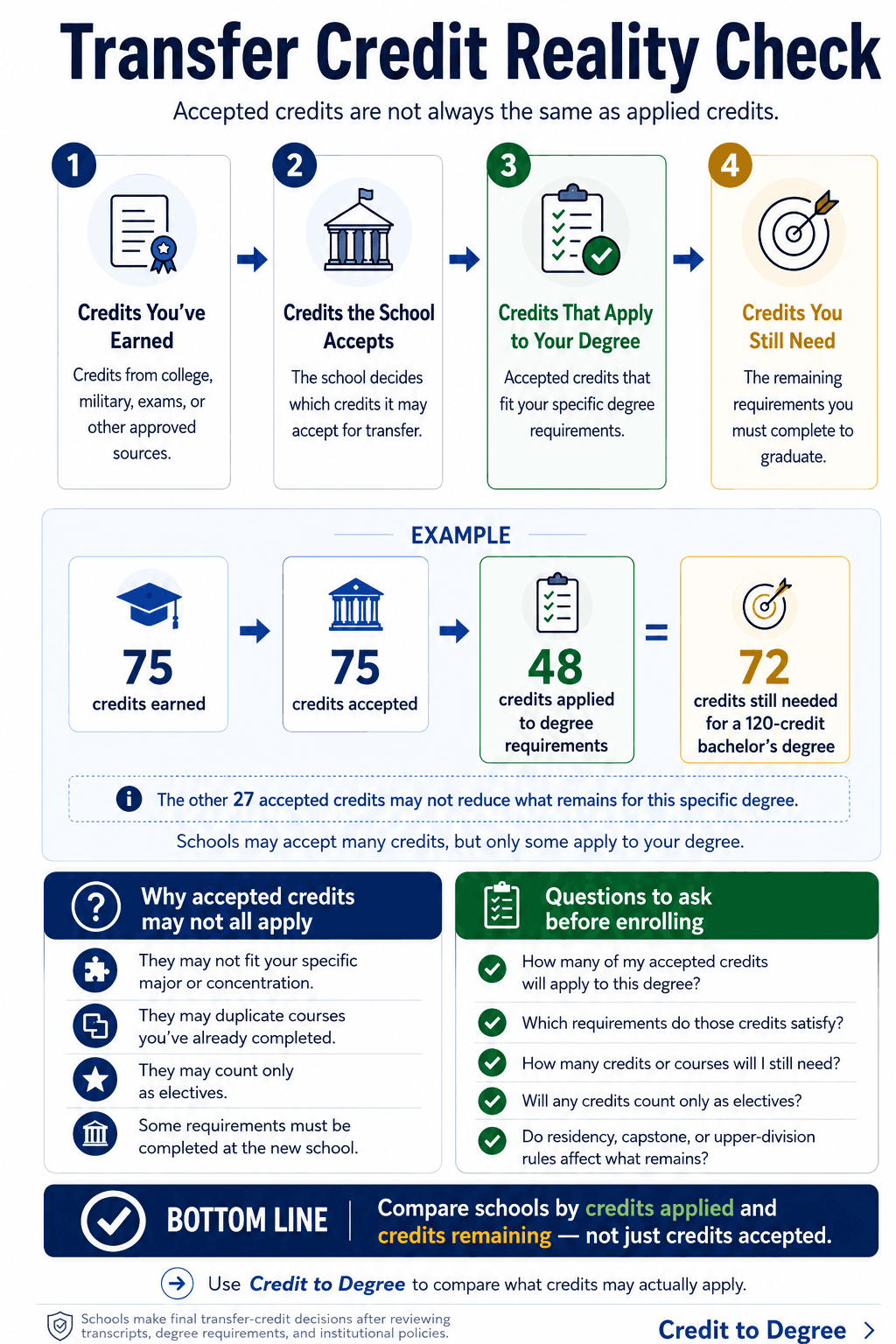
A transfer credit evaluation may show that a school accepts many of your prior credits, but only some apply directly to your degree requirements. Review both the credits applied and the requirements that remain.
When reviewing an evaluation, look beyond the total number of credits accepted. Check whether each credit satisfies general education, major, elective, or other degree requirements—and ask whether residency, capstone, or upper-division rules still affect what you must complete.
The short answer
A transfer credit evaluation is a review of your prior learning.
A school may look at:
Previous college transcripts
Community college credits
Associate degree credits
Military or JST credits
Exam credits such as CLEP or DSST
ACE-recommended learning
Sophia, Study.com, or similar alternative credits
Prior learning assessment, if the school offers it
Professional certifications or workplace learning, depending on the school
After the review, the school may tell you which credits are accepted and how they apply to your degree.
The most useful evaluation does more than list accepted credits. It shows what requirements are already satisfied and what courses or credits you still need.
For background on the bigger credit-transfer question, see What Credits Transfer to a Bachelor’s Degree?.
Why a transfer credit evaluation matters
A transfer credit evaluation can change the whole picture.
Before the evaluation, you may know that you have 30, 60, 90, or more prior credits. But you may not know what those credits are worth in a new program.
After the evaluation, you should have a clearer idea of:
Which credits the school accepts
Which credits apply to general education requirements
Which credits apply to major requirements
Which credits apply as electives
Which credits do not reduce your remaining requirements
How many courses you still need
Whether a different major might use more of your credits
Whether the program is realistic for your goals
This is why a transfer credit evaluation is one of the most important steps before enrolling.
Without it, you may be comparing schools based on guesswork.
Accepted credits are not always applied credits
This is the most important thing to remember.
A school may accept a credit, but that does not always mean the credit applies to your specific degree in a useful way.
For example:
A course may be accepted as elective credit but not satisfy your major.
A course may satisfy a general education requirement.
A course may duplicate another course you already completed.
A course may be accepted by the school but not used toward your selected program.
A course may transfer as lower-division credit even though the degree still requires upper-division coursework.
A credit may appear on your record without reducing the number of remaining courses very much.
So when you get a transfer credit evaluation, do not stop at the total number of accepted credits.
Look at how the credits apply.
For a deeper explanation, read Accepted Credits vs. Applied Credits: What’s the Difference?.
What happens during a transfer credit evaluation?
Each school has its own process, but the basic idea is usually similar.
The school reviews your prior learning and compares it to its own degree requirements.
That may include:
Reviewing your official or unofficial transcripts
Identifying courses that may be eligible for transfer
Comparing those courses to the school’s own course catalog or requirements
Assigning credits to general education, major, elective, or other categories
Checking grade requirements
Checking credit limits
Checking residency requirements
Creating a summary of what credits count and what remains
The exact process can vary. Some schools do this centrally through admissions or the registrar. Others may involve academic departments, especially for major courses or technical subjects.
That is why you should ask how the review works at each school you are considering.
Unofficial vs. official transfer evaluations
Not all transfer credit evaluations carry the same weight.
Some schools may offer an unofficial or preliminary evaluation before you are fully admitted. Others may only complete an official evaluation after admission and after receiving official transcripts.
Both can be useful, but they are not the same.
Unofficial or preliminary evaluation
An unofficial evaluation may help you estimate how your credits might transfer before you enroll.
This can be useful when you are comparing schools. It may help you avoid wasting time on programs that do not use your prior credits well.
But an unofficial evaluation may be limited.
It may be based on unofficial transcripts, incomplete records, general transfer rules, or a quick review. It may not include final department decisions. It may change after official transcripts arrive.
You can use it as a planning tool, but you should not treat it as the final answer unless the school clearly says it is final.
Official evaluation
An official transfer credit evaluation is usually based on official transcripts and the school’s formal review process.
This is the evaluation that matters most before you commit.
An official evaluation should give you a clearer picture of:
Accepted transfer credits
Credits applied to the degree
Remaining requirements
Courses still needed
Any limits or conditions
Degree progress after transfer
Even then, you should review the result carefully and ask questions if something is unclear.
Pursuing an online business bachelor’s degree and comparing options before requesting official evaluations? The Personal Path Review uses your unofficial transcript to compare supported pathways and identify questions to verify with each school. This independent review is for eligible U.S. customers and does not replace an official school evaluation. Learn about the $39 Personal Path Review.
What documents might you need?
A school may ask for several documents before evaluating your credits.
Common examples include:
Official transcripts from every college you attended
Unofficial transcripts for an early estimate
Course descriptions
Syllabi for older or unclear courses
Military Joint Services Transcript, if applicable
CLEP or DSST score reports, if applicable
ACE or alternative credit records, if applicable
Documentation for certifications or prior learning assessment, if the school reviews those
Do not assume that one transcript is enough if you attended more than one school. Many colleges want transcripts from each institution where you earned credit.
If you have credits from multiple places, start gathering records early.
For a step-by-step transfer process, see How to Transfer College Credits to a New School.
How credits may be applied
After reviewing your records, the school may apply credits in different ways.
General education
Some credits may satisfy general education requirements.
These might include writing, math, humanities, social science, natural science, communication, or similar requirements.
For many adult learners, prior community college courses may be especially useful here.
Major requirements
Some credits may satisfy major requirements.
This is often harder to predict. A course from your old school has to match the new program closely enough to count for that requirement.
For example, a previous business course may or may not satisfy a business core requirement at the new school. A computer course may or may not count toward a current technology major. A course from one psychology program may or may not match another school’s psychology requirement.
Major courses may require department review.
Electives
Some credits may apply as electives.
Electives can still help you finish. But there may be a limited number of elective slots in your degree.
If you have more elective credits than the degree can use, the extra accepted credits may not reduce your remaining requirements.
Not applied to the degree
Some credits may be accepted by the institution but not applied to the degree you selected.
That can happen when credits do not fit the degree requirements, duplicate other credits, exceed limits, or do not meet program rules.
This does not mean the credits are worthless. But for your current degree, they may not shorten the path as much as you hoped.
Why your major matters
Your major can change how useful your transfer credits are.
A flexible degree such as general studies, liberal studies, interdisciplinary studies, or some business completion programs may have more room for prior credits.
A more structured major may have less room.
For example, a student with many old credits may find that one degree uses 70 credits while another uses only 48. The school may be the same, but the degree requirements are different.
This is why it can be smart to ask:
“Would another major or concentration use more of my credits?”
That does not mean you should choose a degree you do not want. But it does mean the degree choice matters.
Why residency requirements matter
A residency requirement is a rule about how many credits you must complete through the school awarding the degree.
In this context, residency usually does not mean living on campus. It means completing a certain amount of coursework through that institution.
Residency requirements can limit how much prior credit reduces your remaining path.
For example, even if a school accepts many transfer credits, it may still require you to complete a certain number of credits through that school before graduating.
This is one reason a transfer credit evaluation should show both:
How many credits are accepted
How many credits still need to be completed at that school
If the evaluation does not make this clear, ask.
How transfer evaluations affect time to finish
A transfer credit evaluation can help estimate your timeline, but it still does not guarantee an exact finish date.
Your time to finish may depend on:
Remaining credits
Required courses
Course availability
Whether courses are offered every term
Whether courses have prerequisites
Full-time or part-time enrollment
Term length
Work and family schedule
Whether the program is self-paced, competency-based, or traditionally scheduled
A student who has 75 applied credits may still take longer than expected if required courses are offered only at certain times. Another student with fewer applied credits may move faster in a more flexible format.
So use the evaluation as a planning tool, not a promise.
If speed is your main concern, see Can You Finish a Bachelor’s Degree in One Year?.
How many credits can transfer after an evaluation?
The evaluation should help answer this question, but the answer still depends on the degree.
A school may accept a maximum number of credits, but your actual applied credits could be lower.
If you want a broader explanation, see How Many Credits Can You Transfer to a Bachelor’s Degree?.
If you are specifically looking for high-transfer-credit options, see Colleges Accepting 90 Transfer Credits.
The key is to compare your remaining requirements after the evaluation, not just the school’s maximum transfer policy.
Questions to ask after you receive a transfer evaluation
When you receive a transfer evaluation, read it carefully.
Then ask questions like:
Is this evaluation official or unofficial?
Is it based on official transcripts?
Are all my previous schools included?
How many credits were accepted?
How many credits apply to my degree?
How many apply to general education?
How many apply to my major?
How many apply as electives?
Are any accepted credits not being used?
What courses do I still need?
How many credits must I complete at your school?
Are there residency requirements?
Are there upper-division requirements?
Are any credits still waiting for department review?
Would a different major use more of my credits?
What is the estimated remaining cost?
What is a realistic timeline based on course availability?
Do not be embarrassed to ask these questions. They are exactly the questions an adult learner should ask before making a decision.
Trying to make sense of your credits?
The Credit to Degree Finder can help you think through your starting point and identify which questions matter most before you compare schools.
Find My Degree Completion Options
This is not an official transfer credit evaluation. A college still has to review your transcripts and decide how your credits apply to a specific degree. But the finder can help you prepare better questions before you talk to schools.
Red flags to watch for
A transfer-friendly school should be able to explain how your credits apply.
Be cautious if:
You only get a vague estimate
You are told “most credits should transfer” without detail
No one can explain what requirements remain
You cannot see how credits apply to the major
The school focuses only on accepted credits, not remaining courses
You are pushed to enroll before seeing a clear credit review
Costs are discussed before your remaining requirements are clear
You are not told whether the review is official or unofficial
None of these automatically means a school is bad. But they are reasons to slow down and ask for clearer information.
How to compare two transfer evaluations
If you receive evaluations from more than one school, compare them side by side.
Do not compare only the total credits accepted.
Compare:
Total credits accepted
Total credits applied
Credits applied to general education
Credits applied to the major
Credits applied as electives
Remaining required courses
Remaining credits
Residency requirements
Estimated cost to finish
Course schedule and format
Realistic time to completion
A school that accepts fewer credits may still be better if more of those credits apply directly to your degree.
A school that accepts more credits may still leave you with more required courses.
The best option is usually the one that gives you the clearest and most realistic path from where you are now to the degree you actually want.
For an online business bachelor’s degree, use our five-program business degree-completion comparison to identify the transfer, institutional-credit and tuition questions to put beside each school’s evaluation.
Bottom line
A transfer credit evaluation is one of the most important steps in finishing a bachelor’s degree with prior credits.
It helps show how your old credits may count at a new school. But the most important result is not just how many credits are accepted.
The most important result is how many credits apply to your specific degree requirements and reduce what you still need to complete.
Before enrolling, try to get a clear answer to three questions:
How many credits are accepted?
How many credits apply to this degree?
What exactly do I still need to finish?
If you can answer those questions, you will be in a much stronger position to compare schools, avoid surprises, and choose a degree-completion path that actually fits your situation.
Not sure which path fits your credits?
Old credits, transfer limits, school policies, and degree requirements can change how fast you can actually finish. The safest next step is to compare options based on your real credit situation.