Stop guessing which degree-completion option fits your actual credits.
The Personal Path Review uses your unofficial transcript, priorities, budget, and learning preferences to compare realistic online business degree-completion paths. You’ll receive a source-backed personalized report — not an official evaluation.
One-time beta price. No subscription.
Why the free finder can only go so far
A short finder can help you identify what matters. It cannot compare how your actual coursework may fit the remaining requirements of a specific program.
Personal Path Review
01 Ranked degree-completion paths
02 Source checks and questions to verify
03 A practical next-step plan
What you get
A personalized PDF within 5 business days, built around a ranked shortlist of three supported paths. For each path, you’ll see why it ranked where it did, a side-by-side comparison, official-source tuition, transfer, residency, timing, and delivery information, plus risks, questions to verify, a next-step plan, and official source links. The beta also includes one clarification within 7 days.
See what your review looks like
Your Personal Path Review is delivered as a personalized, source-backed PDF. These pages show a synthetic example, not a paying customer or a promised result. Sample prepared August 28, 2026; school facts in the sample were checked through August 20, 2026.
How this example turns research into a next step
Starting point. A Maine adult seeking an online business/management bachelor’s has 63 credits identified in the sample record, prefers self-paced learning, and wants to finish quickly while controlling cost. The credit total is planning-only: this synthetic case still needs credit-unit verification before a customer report could be delivered.
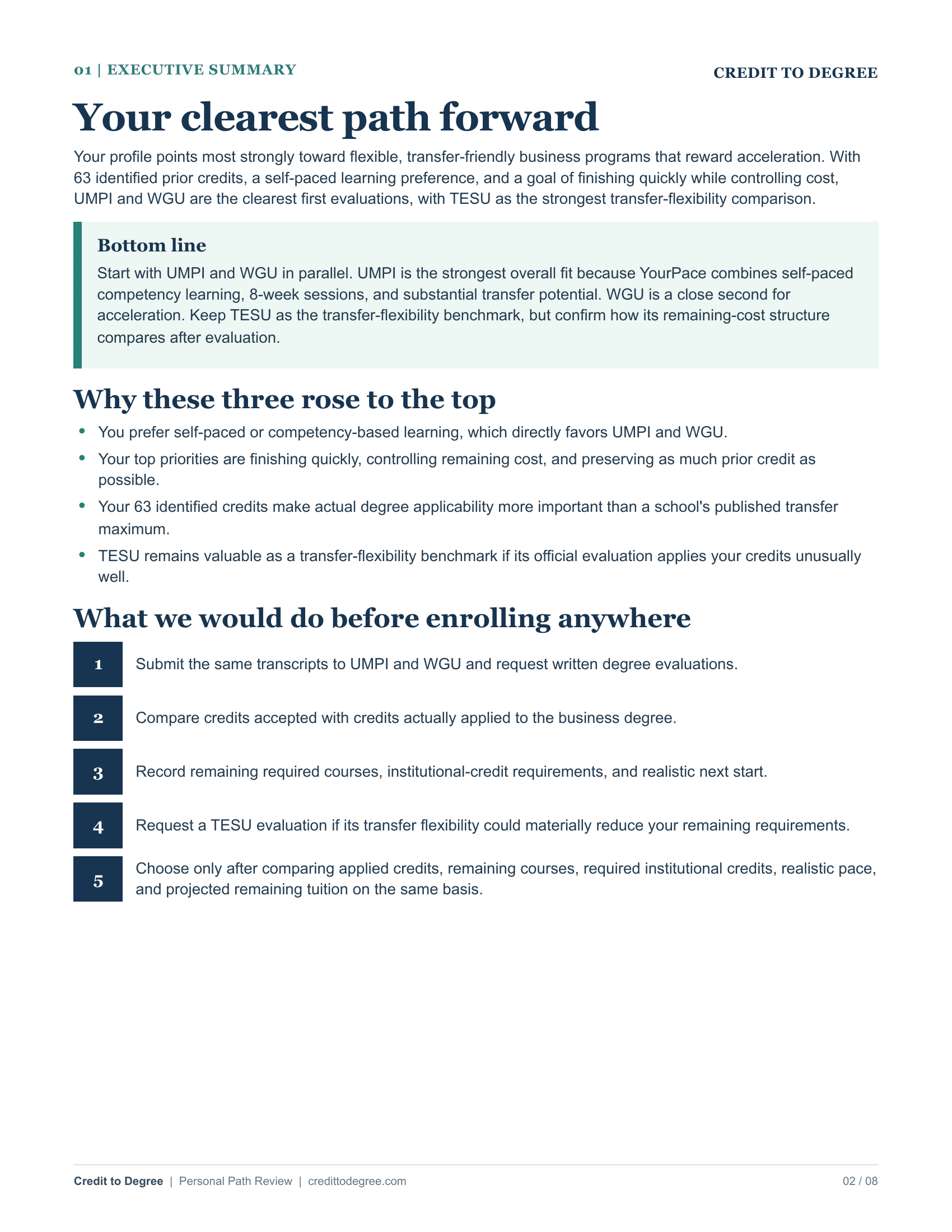
What the review adds. Instead of general program-model guidance, the sample connects that coursework and those priorities to a ranked comparison: UMPI first, WGU second, and TESU third. It explains why each option fits, what could weaken that fit, and which questions to ask next. This ranking is specific to the example.
The tradeoffs. In the sample, UMPI’s 8-week self-paced sessions and WGU’s 6-month competency-based terms suit the stated learning preference. Their practical cost depends on achievable pace and remaining requirements. TESU provides a transfer-flexibility comparison, but its term-based structure and tuition/residency choices may be less suitable for this profile.
What schools must confirm. None of the 63 identified credits is promised to apply. Each school must confirm degree applicability, remaining courses, required institutional credits, current tuition and fees, and a realistic course sequence. The sample does not establish a final cost or graduation date.
The next action. Request written evaluations from UMPI and WGU using the same transcripts. Compare accepted credits, applied credits, remaining requirements, and projected cost on the same basis; use TESU as the additional transfer-flexibility comparison before deciding where to enroll.
Executive Summary
Option Detail

Action Plan

Independent, source-backed, and limited in scope
Credit to Degree is independent and not affiliated with colleges. This beta is for U.S. adults with prior college credit and an unofficial transcript who are exploring supported online business degree-completion paths.
Frequently asked questions
Is this an official evaluation? No. It is a planning review; each college makes final decisions about transfer and degree application.
Do I need an unofficial transcript? Yes. Your unofficial transcript is part of the review input.
When will I receive the report? Within 5 business days.
Is $39 recurring? No. It is a one-time beta price with no subscription.
What happens after purchase? You’ll receive the post-purchase intake and upload steps needed to begin the review.